
From “AI Kaamla” Research to the Kurigram Reality
In 2024, my work was centered on computational notebooks and machine learning terminals in Dhaka. Like many young engineers in Bangladesh, I immersed myself in what I called the “AI Kaamla” phase: an intensive period of applied ML research, model optimization, and data pipeline engineering.
“Some projects are always special, and this Agri project is one of them. It combines my ideas, passions, and hard work, and is now continuously growing and deepening my connection to it.”
Every visit home to Kurigram along the Brahmaputra basin revealed a stark contradiction. While tech circles debated artificial intelligence, smallholders in my village were spending a major share of their Boro harvest cost on diesel for shallow pumps. Meanwhile, conventional “smart agriculture” proved unworkable in the delta: buried soil probes corroded in river silt or broke during field tillage, while ground solar farms require scarce arable farmland.
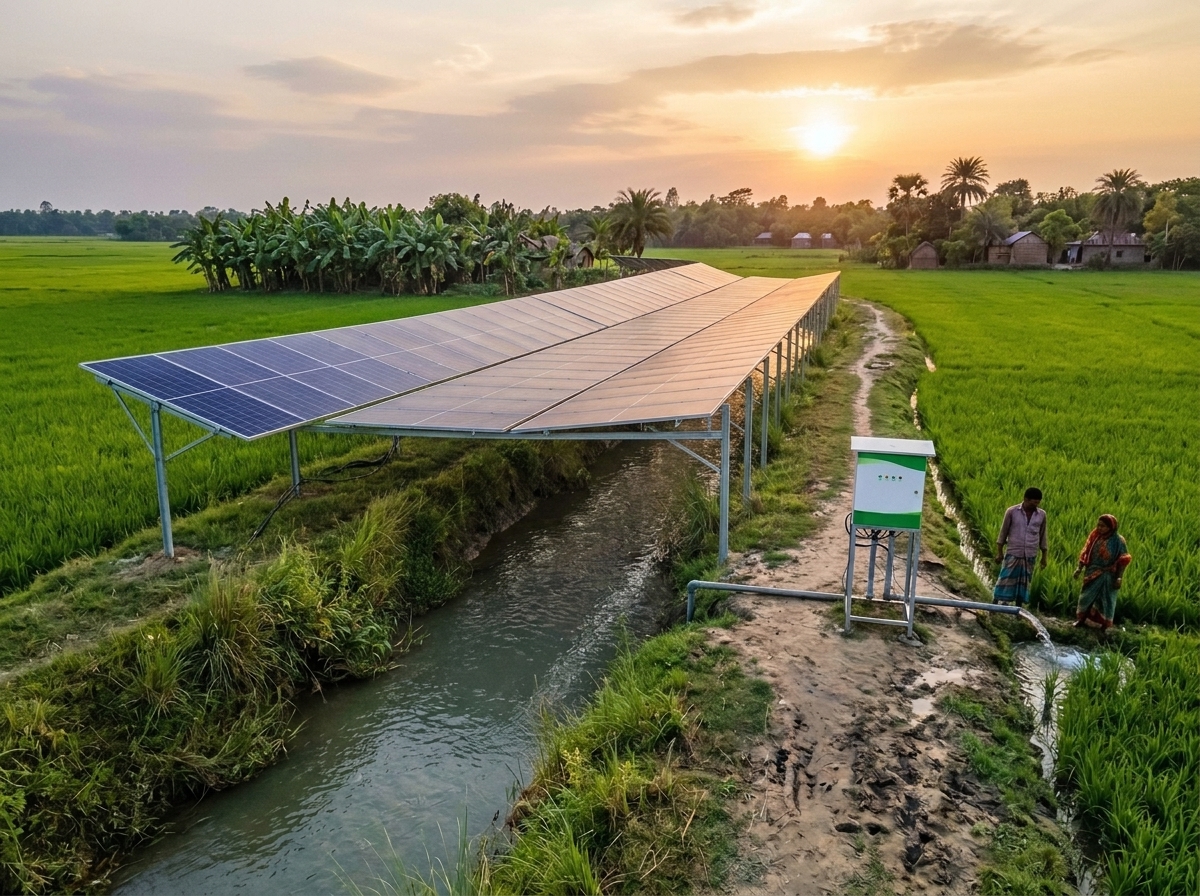
That reality shaped SolariQ around one core principle: minimizing water and pump runtime maximizes clean electricity for the National Grid. When central GeoAI replaces a blind 15-minute pump run with an exact 10-minute quota, farmers save water, cut diesel and rice methane, and divert the remaining 5 minutes (plus all off-season sunshine) straight to the National Grid. Low-profile panels sit above flood water over public dug canals (no concrete bank casting, zero farmland conversion), relays stay dry at safe height, dynamic pre-filtered pumping handles summer shortages, and trained local youth run pump apps while farmers track plot weather and crop status with zero buried soil probes.
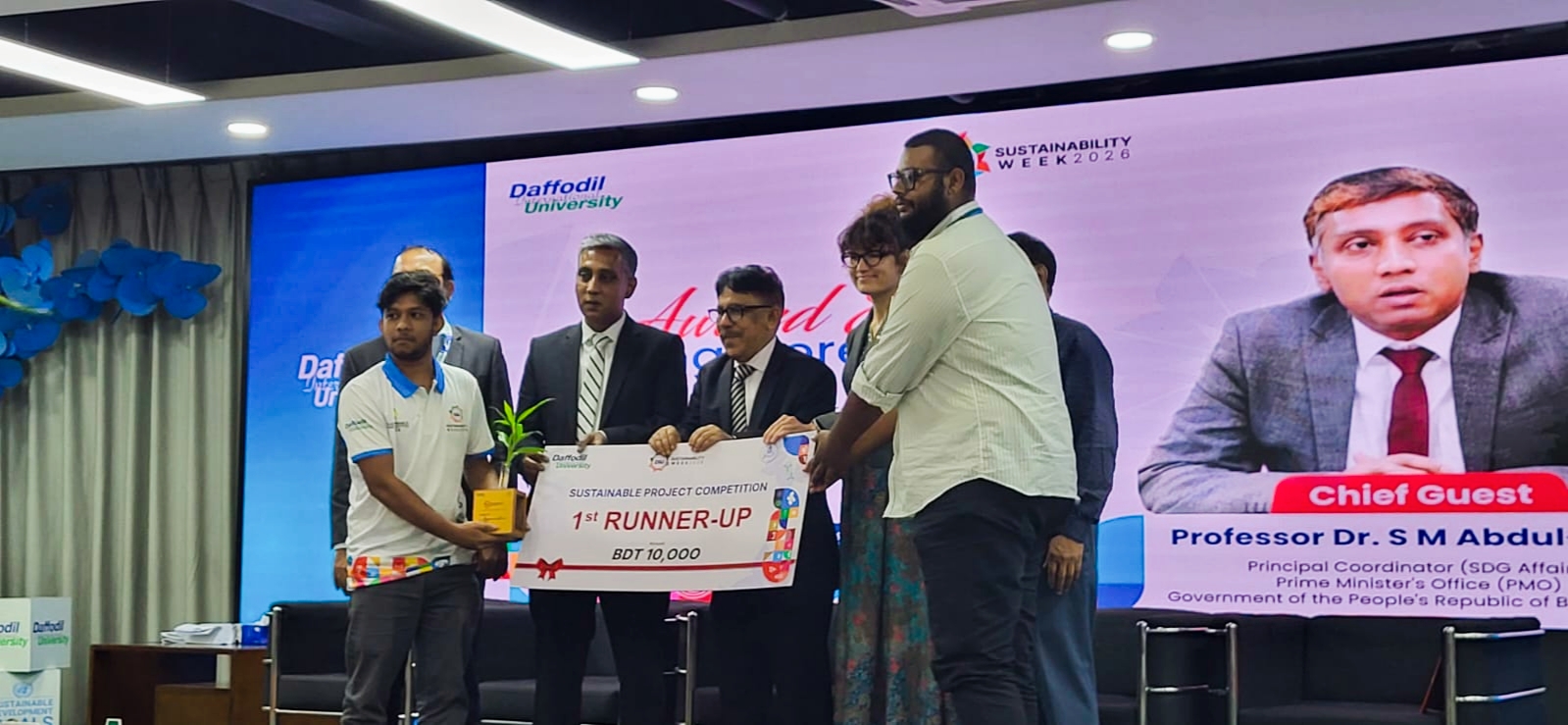
1st Runner-Up at DIU Sustainability Week 2026
Engineering must work in hardware, not just slides. In early 2026, we built a working prototype testbed: ESP microcontrollers, low-power 50 ms pulse relay circuits, and a 6-plot smart valve manifold.
At DIU Sustainability Week 2026, Chief Guest Prof. Dr. S. M. Abdul-Awal, Principal Coordinator (SDG Affairs) at the Prime Minister's Office (PMO), reviewed our prototype demonstration. What resonated most was the closed-loop payoff: using 50ms pulse shutoffs and zero-farmland canal solar to stop over-pumping on time, cut methane and diesel use, and divert surplus solar power into Bangladesh's National Grid (SDG 2, 6, 7 & 13).
SolariQ was awarded 1st Runner-Up. Receiving the award on stage from the Chief Guest gave our early team the momentum to keep testing the architecture rigorously beyond a student competition.
Incubated Backing & Grassroots Grounding in Rangpur
Following the event, Daffodil International University's Sustainability Wing began incubating SolariQ through the Center for Sustainable Innovation and Resilient Futures (CSIRF), led by Assistant Professor Khalid Md. Bahauddin, supporting us with mentorship and active guidance in pursuing pilot grants and institutional partners.
Trophies look nice on university shelves, but crops grow in delta soil. To move from prototype to field validation, we are combining community outreach, technical iteration, and grant mobilization through three aligned partners:
Our team is preparing a 7-day field feasibility and requirement-gathering campaign across Rangpur Division (targeted for December 2026, dates tentative):
- Courtyard Clinics (উঠান বৈঠক): Explaining AWD water-saving practice in plain Bangla and gathering local requirements directly from smallholder farmers.
- Flood-Safe Site Mapping: Measuring seasonal canal water marks so canopies stay low-profile without concrete bank casting, while electronics stay dry above flood level.
- Local Youth Selection: Identifying local youth trainees to run the pumping app while farmers check weather, crop and plot status on their own view.
This groundwork prepares the proposed 100-Meter Canal Pilot at Chatla-Dula Khal, Kurigram, moving forward once stakeholder approvals and pilot grant funding are secured.